












Introduction
As a specialist provider of tachograph implementation, fleet compliance and legally compliant documentation processes, JORLAR has been supporting companies in the European and Swiss transport sectors for many years. The forthcoming regulatory change on 1 July 2026 presents many businesses with significant organisational, technical and legal challenges. Light commercial vehicles over 2.5 tonnes in particular, which have hitherto operated in a largely unregulated sector, will now be fully integrated into social regulations and the tachograph requirement.
JORLAR supports companies not only in meeting these complex requirements, but also in turning them into a strategic advantage: through clear processes, legally compliant systems and the professional implementation of the new and Swiss regulations. This article examines the entire issue in detail and outlines what companies need to know and do now.
New EU regulatory framework for light commercial vehicles over 2.5 tonnes from 1 July 2026
A comprehensive analysis of the European and Swiss implementation, its obligations, risks and structural implications for businesses
On 1 July 2026, the European Union will introduce a far-reaching reform that will bring about lasting change to the transport sector. For the first time, light commercial vehicles over 2.5 tonnes used in cross-border freight transport will be fully included within the scope of social regulations and the tachograph requirement. This brings to an end the special status enjoyed for decades by this vehicle category, which has remained largely unregulated until now. The new rules form part of Mobility Package I and are intended to eliminate distortions of competition, enhance road safety and improve drivers’ working conditions.
It is worth noting that this regulation applies not only within the EU but is also being fully adopted by Ελβετία, even though it is not an EU member state. Switzerland traditionally follows European transport standards to ensure compatibility in cross-border transport. This creates a uniform legal framework for companies operating between EU member states and Switzerland.
Why the new rules are being introduced
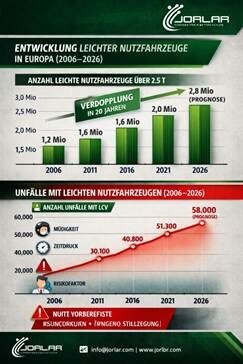
Light commercial vehicles weighing between 2.5 and 3.5 tonnes have been used increasingly for international transport in recent years. Many companies deliberately used this vehicle category to circumvent the strict regulations for heavy goods vehicles. This led to significant distortions of competition: whilst traditional lorry fleets had to comply with strict and rest periods, light vehicles were able to operate almost without restriction. At the same time, accident figures rose and the strain on drivers, who often worked under considerable time pressure, increased.
The EU is now responding by harmonising the rules to ensure safety, fairness and transparency in the single market. Switzerland is aligning itself with this harmonisation to ensure equal treatment within the European transport area and to standardise border controls.
Which vehicles are affected
The new regulations apply to all light commercial vehicles over 2.5 tonnes used in cross-border freight transport or cabotage. This brings these vehicles into line with heavy goods vehicles in legal terms. Vehicles under 2.5 tonnes and light commercial vehicles used exclusively within a single Member State are not affected.
The same definition applies to Switzerland: vehicles over 2.5 tonnes used commercially in international transport are now subject to the same obligations as heavy goods vehicles. The Swiss authorities have announced that they will align their implementation closely with EU rules to ensure consistent enforcement practices.
Driving and rest periods: Full adoption of the lorry regulations
Under the reform, the same and rest periods apply to drivers of light commercial vehicles as to drivers of heavy goods vehicles. The daily driving time is limited to a maximum of nine hours, although an extension to ten hours is permitted on two days per week. The weekly driving time must not exceed 56 hours, and a maximum of 90 hours is permitted within any two-week period.
Rest periods are also adopted in full: drivers must observe at least eleven hours’ rest each day, which may be divided into one three-hour and one nine-hour period. The weekly rest period is normally 45 hours, but may be reduced to 24 hours once every two weeks, provided that the rest is made up later.
These rules apply in exactly the same way in Switzerland, as the Swiss regulatory authorities have been applying the EU social regulations for years and are now extending them to light commercial vehicles as well.
The tachograph requirement: introduction of the G2V2 smart tachograph
The key technical element of the reform is the mandatory introduction of the second-generation smart tachograph (G2V2). From 1 July 2026, all affected vehicles must be fitted with this device. The G2V2 smart tachograph automatically records driving times, breaks, rest periods and location data. It communicates via GNSS satellites, features encrypted data transmission and enables authorities to remotely access certain data whilst the vehicle is in motion.
Switzerland is also fully adopting this requirement. The cantonal police authorities have announced that vehicles without a tachograph or a driver card will be penalised with immediate effect once the regulation comes into force.
Of particular relevance are the penalties that have already been confirmed:
- a fine of 2,000 CHF if a driver is on the road without a driver card
- A fine of 400 CHF if a vehicle is driven without the prescribed tachograph
These penalties apply regardless of whether the company is based in the EU or Switzerland. The only decisive factors are that the vehicle is used for commercial purposes, exceeds the 2.5-tonne limit and is engaged in cross-border transport.
Posting of drivers: New obligations in international transport
The reform affects not only technical equipment but also labour law aspects. Drivers of light commercial vehicles will in future be regarded as posted if they carry out cabotage or cross-trade operations. In such cases, companies must register the drivers via the European IMI system, comply with local minimum wage requirements and keep comprehensive documentation on board the vehicle.
Switzerland is also adopting this regulation. Drivers carrying out cabotage or cross-trade in Switzerland must be registered in accordance with Swiss posting legislation. Switzerland strictly enforces these requirements and imposes heavy fines for breaches.
Practical example: Cross-border deliveries by a bakery or butcher’s shop
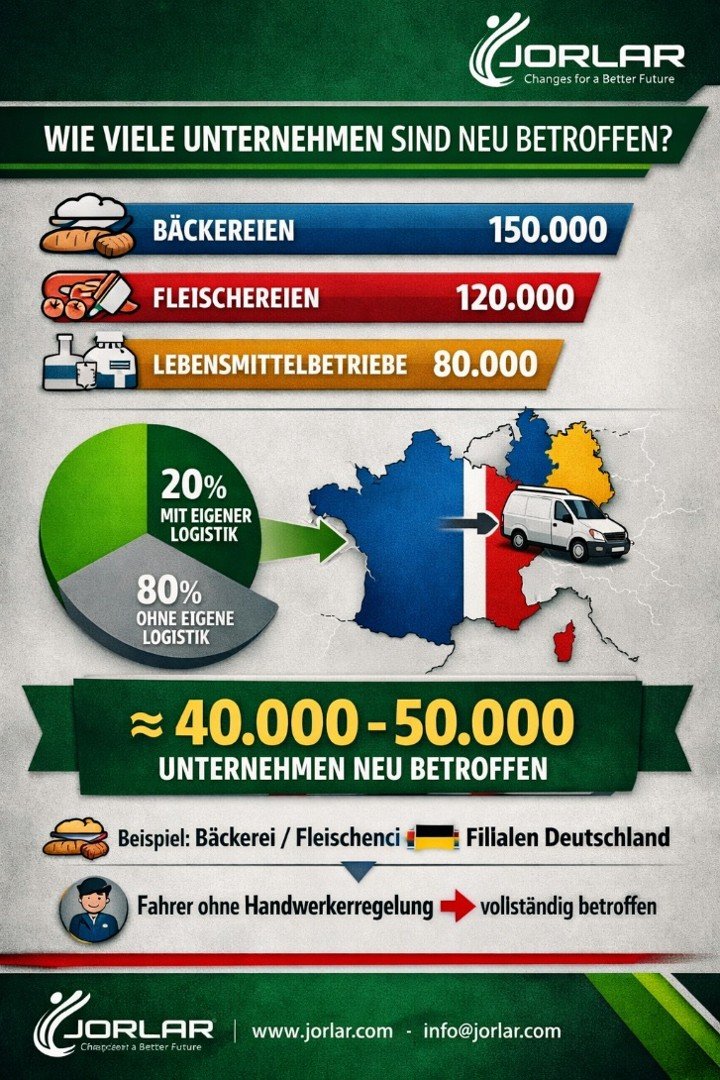
A particularly clear example of the new rules is a bakery or butcher’s shop that operates its production facility in France and regularly supplies its branches in Germany with fresh goods. Until now, these deliveries were often carried out using vans or Sprinters with a maximum authorised mass of over 2.5 tonnes, without the drivers being subject to the strict social regulations.
However, as these drivers work exclusively as drivers and do δεν carry out any manual work relating to production or assembly, the so-called ‘craftsmen’s exemption’ does not apply to them. This exemption applies only to craft businesses whose drivers transport materials or tools to building sites or customers and carry out manual work there themselves.
In the case of the bakery or butcher’s, the transport is purely the movement of goods between business premises, i.e. commercial goods transport. These journeys therefore fall entirely under the new and Swiss regulations. In future, drivers must document their and rest periods, vehicles must be fitted with a G2V2 smart tachograph, and companies must implement the relevant compliance processes.
This example clearly shows that the regulations affect not only traditional haulage contractors but also smaller businesses with their own logistics operations that regularly operate across borders. It is precisely these companies that should plan for the transition well in advance to avoid fines, vehicle immobilisation and delivery delays.
The practical challenges for companies
The regulatory change presents companies with major organisational challenges. Fleets that previously operated flexibly and without strict guidelines must now be managed like fully regulated lorry fleets. Route planning, dispatching, driver communication and compliance must be restructured.
In particular, companies that regularly operate between EU member states and Switzerland must adapt to two control systems, which are, however, identical in substance. Whilst this creates a uniform legal framework, it also leads to increased scrutiny, as Switzerland traditionally carries out very rigorous checks.
Risks of failing to prepare
Companies that ignore or underestimate the transition are taking considerable risks. During inspections, vehicles can be taken off the road immediately if they are not equipped in accordance with the regulations. Fines can mount up across several countries, as offences are often penalised in different jurisdictions.
In Switzerland, the penalties are particularly severe: the cantonal police authorities have announced that infringements will be penalised from day one. A missing tachograph or driver card can therefore lead immediately to high costs and the vehicle being taken off the road.
What companies need to do now
The first step is to carry out a comprehensive review. Companies must check which vehicles are affected, which drivers are deployed internationally, and which journeys are cross-border or constitute cabotage. Technical measures must then be planned: selecting suitable tachographs, planning their installation, issuing driver cards and introducing a data management system.
At the same time, organisational processes must be adapted. In future, the dispatch department must plan routes in accordance with and rest periods, the HR department must correctly report postings, and fleet management must monitor tachograph data. Training is essential to ensure that drivers understand and correctly apply the new rules.
Outlook: National implementation likely
It is to be expected that this regulation will also be transposed into the national law of many countries in the foreseeable future – even in those where it has so far only applied to cross-border transport. The reason is obvious: national implementation would significantly simplify checks, as authorities would no longer have to distinguish between international and domestic journeys.
Furthermore, such harmonisation would also eliminate existing distortions of competition in domestic freight transport. At present, companies operating exclusively within a single country can still benefit from less stringent regulations. This leads to unequal conditions between domestic and international operators.
The political and regulatory trend is clearly moving towards uniform standards for all commercial vehicles over 2.5 tonnes, regardless of whether they operate cross-border or domestically. In the long term, the Mobility Package would thus become a Europe-wide and Swiss framework that creates a level playing field in terms of, conditions and competition for all market participants.
Conclusion: A far-reaching transformation of the European and Swiss transport sector
The new EU rules for light commercial vehicles over 2.5 tonnes mark a turning point. They establish uniform standards, enhance safety and ensure fair competition. Switzerland is adopting these rules in full and implementing them with great rigour. This creates a harmonised legal framework that provides companies with clear guidelines, but also imposes high standards.
Those who tackle the transition early on can turn this obligation into an opportunity: a fleet that is legally compliant, efficient and future-proof — both in the EU and in Switzerland.
JORLAR’s contact details
JORLAR is always available to assist companies requiring support with the implementation of the new and Swiss regulations:
📞 Telephone: +420 734 260 766📧 Email: info@jorlar.com🌐 Website: www.jorlar.com
👉 Direct link: https://www.jorlar.com